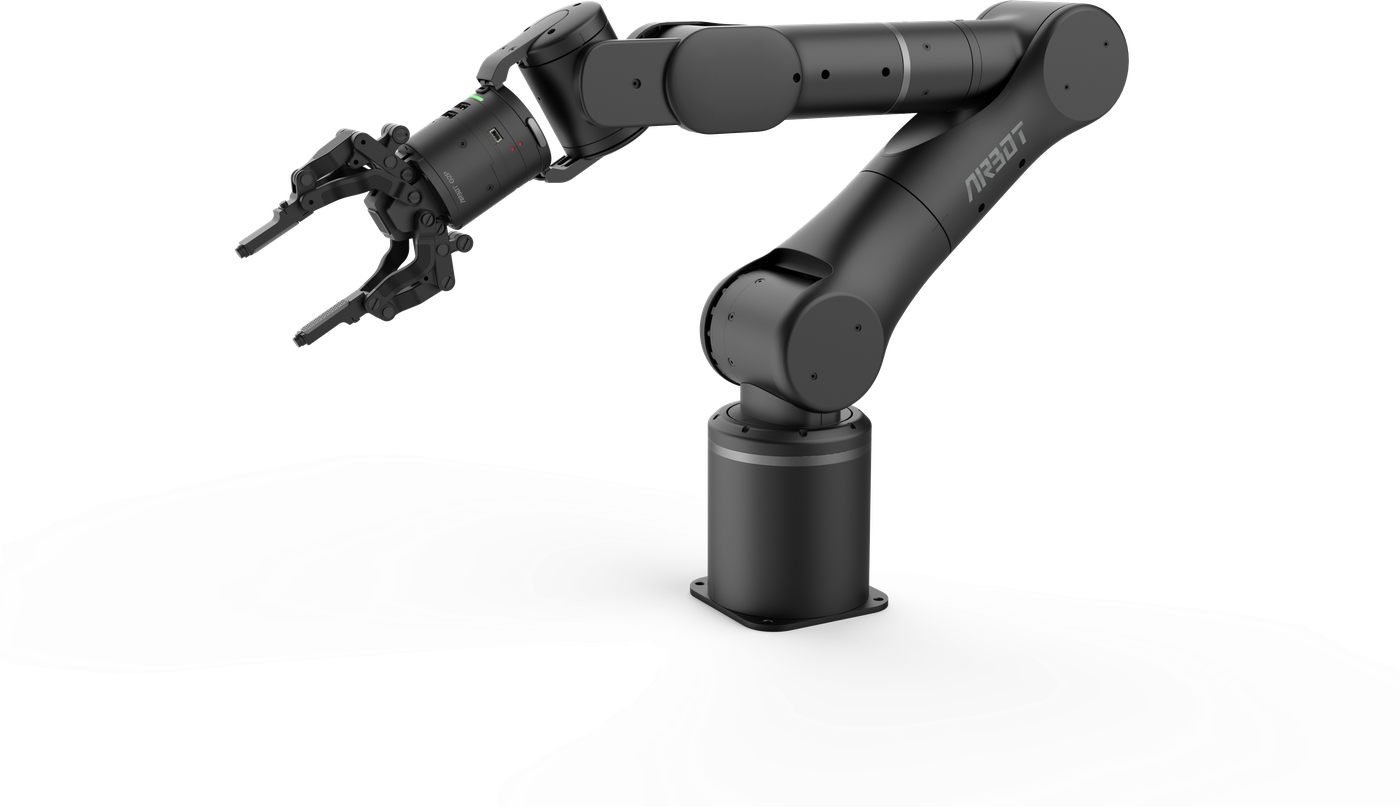
Robot Arm State and Indicator Effects#
ServiceState.fsm_state represents the current high-level operating state of P7. It determines what type of command the
service can accept; the control lease determines which client can send ordinary control commands. The robot arm processes a
corresponding motion request only when both conditions are satisfied.
State Groups#
| State | Meaning | Recommended Action |
|---|---|---|
IDLE |
Does not process ordinary motion targets | Acquire control authority and switch to the required mode |
PLANNING_CONTROL |
Accepts planned motion | Send a single-target or waypoint plan; when busy, first confirm whether the previous task has ended |
SERVO_CONTROL |
Accepts joint or Cartesian Servo targets | Maintain stable sending; actively switch back to IDLE when finished |
GRAVITY_COMPENSATION |
Gravity compensation is active | Support the robot arm while teaching; switch back to IDLE afterward |
FORCE_CONTROL |
Accepts MIT joint commands exposed by the SDK | Use only parameters validated for the current complete system and payload |
POSITION_CONTROL |
Direct-position-control state retained by the wire protocol | No corresponding current SDK enum; switch back to a publicly supported mode |
EMERGENCY_STOPPED |
A software emergency-stop request has entered the state machine | Eliminate the hazard, reset according to the on-site procedure, and confirm IDLE |
IN_COLLISION |
Collision monitoring triggered protection | Keep stopped, record the scene and state, and follow the delivered recovery workflow |
UNKNOWN_ERROR |
Communication, motor, or other hardware state triggered protection | Identify and eliminate the cause before using the supported error-clearing workflow |
UNKNOWN |
The SDK cannot map the received state value | Do not send motion; record versions and logs and check compatibility |
PLANNING_CONTROL does not distinguish between waiting for a request and executing a trajectory. Likewise, IDLE does
not mean that no other client holds control authority or that the physical emergency stop has been reset.
Read-Only Check#
state = client.get_service_state()
if state is None:
    raise RuntimeError("服务状态缓存尚未建立")
if not state.valid or not state.service_state:
    raise RuntimeError("服务状态不可用或已经过期")

print("FSM:", state.fsm_state)
print("controller:", state.controller_state)
Reading state does not acquire control authority or trigger motion. On the DDS backend, valid can briefly be False
between adjacent polls on a healthy connection. For ongoing diagnostics, evaluate it together with service_state and
subsequent samples.
Protection States#
Software emergency stop, collision, and UNKNOWN_ERROR require different recovery workflows. An ordinary stop, releasing
the lease, or closing the client cannot replace protection-state recovery; a software emergency stop also cannot replace the
physical emergency stop. See Motor Error Code Troubleshooting for details.
Status Indicator Reference#
The P7 status indicator is located at the end of the robot arm. Its color and animation can help identify an operating phase
quickly, but they cannot replace ServiceState, motor state, and on-site safety checks.
| Operating State | Indicator Effect |
|---|---|
Brakes engaged; robot_app not started |
Steady white |
Brakes engaged; robot_app starting |
Flashing yellow |
Brakes engaged; control service in IDLE |
Steady yellow |
Brakes released; in SERVO_CONTROL |
Steady green |
| Teaching replay ready or replaying | Flashing green |
| Teaching replay returning to the initial point | Steady green |
In GRAVITY_COMPENSATION |
Steady blue |
| Recording in gravity-compensation mode | Flashing blue |
In POSITION_CONTROL |
Steady gray-green |
In FORCE_CONTROL |
Steady purple |
In UNKNOWN_ERROR |
Steady pink |
For product usage instructions for the indicator, see Robot Arm Status Indicator.
For programmable state fields, see ServiceState (Server State).